
The role of the cello has evolved dramatically
—from a simple rhythmic bass line in the continuo to a true singing voice. Its accessories have transformed as well: strings, endpins, and fine tuners now offer a level of comfort, power, and virtuosity that earlier generations could scarcely imagine.
But why has the endpin—an invention barely a century old—grown to nearly three times its original length?
The Playing Positions
WITHOUT ENDPIN
This is the baroque posture. Following the example of the viola da gamba, the instrument is held upright between the legs. The sound is projected “horizontally.”
The musician’s body, wrapped closely around the instrument, limits both the projection of the sound and the freedom of bow movement.
The upper body remains far from the neck of the instrument, making it difficult to see the left hand—especially in the higher positions—unless one bends forward. Such a posture does not favour the relaxed virtuosity required for expressive playing.
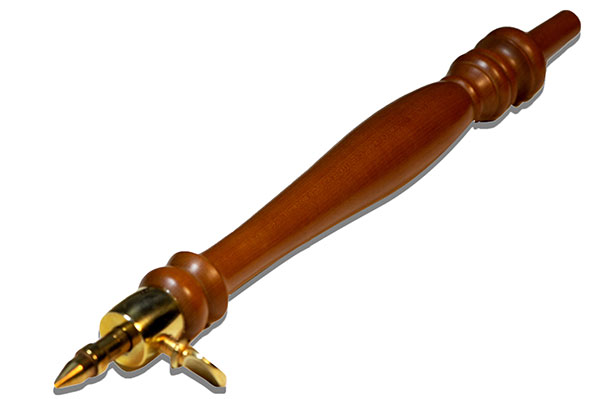
SHORT ENDPIN
With the arrival of the short endpin, the instrument’s position changed little, but the musician’s posture evolved significantly.
He can now lean forward from the feet, gaining strength in both hands through gravity. High positions become easier to reach, and the player hears himself more clearly.
The physical body and the instrument become more stable, creating a closer, more intimate connection. The body no longer blocks the vibration of the wood.
In extreme cases, this posture reveals a kind of coiling of the body around the cello (as noted by B. Michelin).
Stage fright often creates tension: the head drops, the legs grip the chair, the body curls inward. In this cocoon-like shape, can the musician truly project sound to the back of the hall?
This is likely what encouraged the adoption of a longer endpin: raising the cello so that it rests against the ribs, just below the chest.
LONG ENDPIN
Until the late 19th century, women were discouraged from playing the cello—though not the viola da gamba—for supposed reasons of modesty. Fortunately, such arguments eventually faded. One of the earliest photographs of a female cellist is of Guilhermina Suggia, the first wife of Pablo Casals.
It is often thought that the long endpin became widespread thanks to women, for whom the upper part of the instrument would otherwise press uncomfortably against the chest.
With the long endpin, the playing technique changed.
The instrument tilts backward, and the sound travels upward.
The cello sits farther from the body, giving musicians new freedom of movement, flexibility, and agility.
The arms can drop their weight more naturally onto the strings, reducing tension in the back. The body opens, feels more secure, and the player sees and hears the instrument more clearly.
However, some disadvantages appear:
- The angled endpin grips the floor less securely, increasing the risk of slipping.
- The longer rod is more flexible, making the instrument less stable under the bow.
- Sound projection is directed upward due to the backward tilt—does this alter the balance of the concert hall or orchestra?
- The downward pressure on the endpin creates a twisting force on the lower block of the instrument—was the cello originally designed to withstand this?
Modern Solutions
Musicians travel constantly, and cellists know this well—especially when carrying a large flight case.
To counteract the flexibility of long metal rods, steel tubes were once used to reinforce them. Today, only one material truly meets the requirements: carbon fibre, extraordinarily light and rigid.
Preventing Endpin Slippage
A poorly anchored endpin may skid because the point is blunt, the floor is new, or the surface is marble or tile.
Since one cannot drive the endpin directly into such floors, it is advisable to place a personal wooden platform beneath the chair.
Gadget-like accessories rarely solve the problem. If the endpin can be planted, it should be—sound quality depends on it.
Try placing a tuning fork on rubber: you hear nothing.
The same principle applies to the cello endpin. Its contact with the floor must be firm and solid to transmit vibration. Only then will the cello, like the arms of a tuning fork, form a complete vibrating loop and project its full resonance.