
ALADFI Congress – May 1998, Aix‑les‑Bains
(translated from personal notes)
Many respectable 200‑year‑old cellos, passing through auction rooms, have caught my eye. Seeing them, I felt a sense of incongruity, rather like a period piece of furniture covered in synthetic veneer. Irresistibly drawn to the gleaming plastic tailpiece, unable to see anything else, I found myself fuming that this indecent “g-string” was obscuring the instrument itself. Clearly, something could be improved in this tailpiece, at least for the sake of aesthetic unity.
I am a maker of accessories, and my direct experience with setup and adjustment is limited. Nevertheless, I have questions to raise about the evolution of Quartet accessories.
The bridge, positioned at the very centre, is the acoustic centre of gravity of the instrument. It is the source point of the sound; it is therefore natural that it has become the main focus of attention. Every luthier devotes extreme care to it, both in its conception and in its practical execution.
This component, made and remade so often, invites experimentation and the use of personal techniques. It reflects the maker and the deeper meaning of his work, which brings the instrument to the height of its possibilities. Such a focus has often left other components, the accessories, in the shadows.
Who would have imagined, for example, that the accessories of a violin (fingerboard included) account for a quarter of its total weight?
We are far from the time of Stradivari, who even designed metal fittings, magnificent violin‑case hinges. Industrial specialisation has divided the tasks… and the luthier no longer made tailpieces, pegs or chinrests. He bought them, and their evolution slipped from his hands.
I wondered why these accessories, honest components of a beautiful object, a beautiful tool we call a violin, have changed so much. The chinrest, now five times larger than it was a century ago; the cello endpin, three times longer over the same period, while the instruments themselves have changed very little, this raises questions.
These accessories, the interface and point of contact with the musician, were the first to respond to the technical demands brought about by musical and cultural evolution.
Do these transformations in accessories respect the instrument? Do they allow it to retain all its potential as a sound‑producing tool?
But let us return to the cello tailpiece.
In terms of its acoustic and mechanical function, it is clear that a good tailpiece will not work miracles, neither on a Strad nor on a soapbox, even if it can help in many situations.
This is a subject that has interested few luthiers, no doubt because this industrial component comes from outside the workshop. The tailpiece is often fitted as it comes. The luthier must therefore “make do” and adjust other parameters during tonal setup. The evolution of the tailpiece over the past hundred years does not seem to me to be linked to the acoustic, mechanical or aesthetic needs of the instrument. Here are a few examples…
A notable reduction in the width of the head on Mirecourt ebony tailpieces at the beginning of the century, probably to save wood. The ebony plate of the post‑Baroque tailpiece thickened, and thickened again, gaining weight as more porous or less carefully selected ebony was used in industrial production. The aim was to avoid breakage.
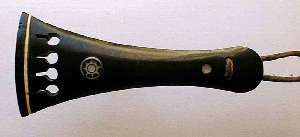
19th century French violin tailpiece
Wide and light (11.2 grams)
Industrial evolution: saving wood
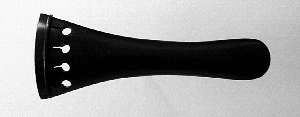
20th century French violin tailpiece
Narrower, thicker, and heavier (13.8 grams)
The adoption of the German “tulip” shape, which facilitates machine production, as well as the rounding of the two corners to minimise accidental snagging by a lock of hair or a garment, all at the cost of an unfortunate aesthetic change.
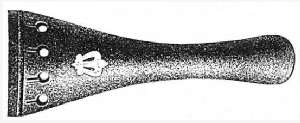
Industrial evolution: optimisation for machine work
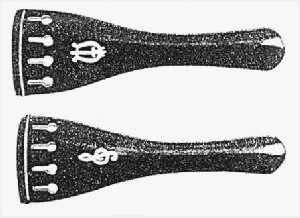
The integration of fine tuners, requested by musicians, was quickly and robustly solved by industry, and when I say robust, I mean robust: two fine tuners alone weigh as much as a Mirecourt ebony tailpiece.
The use of adjustable nylon tailgut, replacing the old gut cord, which acoustically seems far more interesting.
For a century, the German musical accessory industry has supplied, and still supplies, the entire world. Its merit has been to contribute effectively to the democratisation of musical practice: solid and inexpensive.
French and English production, well‑known since the 19th century, disappeared in the 1950s. I am thinking of M. Ruer of Mirecourt or the Hill workshop in London.
Let us look at the cello tailpieces available on the market today:
– The Pusch: its system, with many metal parts, is not very effective for fine tuning. Its advantage was that it was the only wooden tailpiece available.
– The Akustikus, made of plastic, works very well and is inexpensive. I regret its appearance, and I was surprised to find that it weighs as much as a traditional ebony tailpiece.
– Finally, the Wittner, which I believe is widely used because it is more aesthetically successful and functions well. Its cast‑aluminium material, however, penalises it in terms of weight (50% more than an ebony tailpiece).
The question of lightness was the starting point of my reflections. Weight alone seems an insufficient criterion, for seeing that Akustikus and Wittner work well, the quality of the material must also play a role: one is light and soft, the other heavy but rigid.
Another essential factor, in my view, is the distribution of weight along the tailpiece: for tailpieces with built‑in metal tuners, most of the weight is concentrated at the top, just a few centimetres from the bridge. Is this not effectively a mute?
The final point, equally important, is the tailgut and the flexibility of this joint.
The starting point of the sound is indeed the bridge. Its freedom to rock from one foot to the other, its freedom to sway, seems essential.
So I carried out an experiment.
While a cellist was playing, I attached a 40 gram weight with a small clamp to different points on the tailpiece. The balance of the four strings changed immediately, and the most critical point was at the top, where the strings begin: the sound became unevenly damped, the response slower. The excess weight of the tuners therefore acts as a mute.
This led me to design a new tailpiece, the “Harmonie” range: very light composite tuners integrated into a fine wooden tailpiece (ebony or boxwood), light in itself.
The rigidity or sound‑conducting ability of the tailpiece material seems less important. However, comparative tests between a African Blackwood tailpiece and a light pernambuco tailpiece seem significant to me.
Judging the sonic contribution of the tailpiece is difficult, especially after the instrument has been reassembled or newly adjusted…
Nevertheless, in this experiment, two families of sound emerged: with African Blackwood, a broad and pointed tone, well articulated; with pernambuco, a brilliant, dense and quick response.
Comparing these sounds with another instrument, the guitar, ebony produced a “classical guitar” tone, while pernambuco evoked a “flamenco guitar”.
Why use pernambuco? It was already used in Mirecourt during the war, when ebony was scarce, to make tailpieces. At the time, no one found anything particularly interesting in its sound.
I shall return to this.
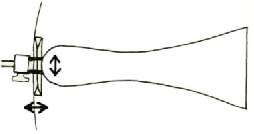
The tailgut attachment
If traditional gut is no longer used, it is to make it easier to adjust the bridge‑to‑tailpiece length. The use of threaded nylon has unfortunately become widespread without taking the time to compare the respective qualities of nylon and gut. Once again, a soft material such as nylon is more inclined to dampen the vibration of the tailpiece, and therefore to hinder the rocking motion of the bridge.
Two small experiments bear witness to this:
A light immobilisation of the tailpiece foot using two small boards resting on the edge of the table: the sound becomes duller and loses power. Sonagram analysis shows a significant reduction in acoustic energy below 1000 hertz. This places us in the same situation as the viola da gamba, where the tailpiece foot is fixed.
Widening or narrowing the two strands of the tailgut alters the tonal balance of the four strings.
The quality of the sound seems to me unquestionably linked to the freedom of rotation of the tailpiece.
The length and spacing of the two strands of the tailgut influence the freedom of movement of the tailpiece.
The use of a steel tailgut often seems to suit luthiers, at least acoustically if not aesthetically. I do not know the reason, but steel is stiffer than nylon, and in this configuration the two strands are often closer together.
Thus, favouring the tailpiece’s ability to vibrate, by various means, seems worthwhile. A few avenues remain to be explored, for example:
- Lengthening the tailgut by using a shorter tailpiece.
- Trying other synthetic materials with an elasticity coefficient close to that of gut.
- Fitting the tailgut in the “baroque” manner, as a saddle, which should free the tailpiece. Indeed, when the tailgut exits from underneath, it constrains the tailpiece less than the modern system, where it exits from the middle of the tailpiece’s thickness.
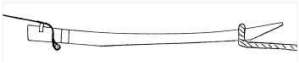
Baroque saddle style tailgut: better rotational freedom for the tailpiece.

Modern tailgut.
- The use of a single‑strand tailgut, as already practised by Roger Lanne in Paris.
Many other experiments remain to be carried out on tailpieces, such as: - Varying the spacing of the strings at the tailpiece exit, which will influence the freedom of movement of the bridge.
- Naturally, trying different weights and different species of wood. One may also note the natural resonance frequency of each tailpiece and the speed of acoustic transmission of the material (I am thinking of the Lucci machine used by some bow makers).
Should a tailpiece be tuned?
It can be tuned like a xylophone bar, to obtain a pitch, often between G4 and E5. Is the natural resonance frequency of this component important? Does tuning a tailpiece for an instrument with a particular wolf note or a dip on a certain pitch have any effect?
One may also study variations in the curvature behind the bridge: French tailpieces have an arch that follows the same curve as the bridge, whereas Hill tailpieces, English in style, are much flatter, somewhat like baroque tailpieces. The curvature for the A and C strings is less pronounced than for the D and G.
This is the direction in which I am currently working with an acoustic‑experiment commission.
How can one validate the “progress” or “results” of such experiments? This is a difficulty for me, and I would like to recount the episode of the pernambuco.
Three years ago, an experiment was launched in Tokyo by a French luthier, involving accessories, mainly tailpieces, made of pernambuco. I was the maker.
At first, I did not believe in the virtues of this wood, and I assumed that the commercial or charismatic influence of this luthier had imposed this fashion.
For the musicians, the result was miraculous.
But where did this result originate? In their minds, or in the pernambuco?
I then carried out an experiment with two groups of luthiers: I asked the first group (people generally favourable to innovative trials) to test this extraordinary new tailpiece.
The second group, chosen among luthiers who were highly sceptical, also had to try it.
The outcome for both groups was identical: six out of ten found an improvement, quicker and easier sound production, greater openness of the instrument, and sometimes a reduction of certain unwanted noises.
One may conclude that in this situation, the product spoke for itself, with little (or despite) human interference: the experiment therefore seems valid.
I therefore question the reliability of experimental methods, knowing that no instrument is ever adjusted or played in exactly the same way twice. Even if the results are real, they will not necessarily apply to the next instrument…
Through this evolution over the past century, I have shown that the tailpiece has become foreign to the instrument. Its modifications have belonged partly to industry, which has overlooked the tailpiece’s role as an acoustic transmitter (as well as the difficulty of using good wood), and partly to musicians, who have demanded fine tuners for legitimate modern comfort, but at the cost of a detrimental increase in weight and a loss of tonal quality.
For both luthier and musician, the accessory is often reduced to the mechanical function it must fulfil: it seems invisible as long as it works.
You notice your car or your telephone far more when they break down.
Thus, it may seem natural to see a Strad cello with a shiny plastic tailpiece at a Sotheby’s sale… the tailpiece has become transparent.