400 Years Old… The Violin
I will not recount here the entire history of the violin, nor attempt a musicological thesis. Many pages have already been devoted to that subject. Instead, I will highlight a few aspects that are rarely mentioned.
The violin has evolved alongside society itself. Art and culture have been shaped by money, power, and religion—yet none of these forces have prevented genius from flourishing.
I will also touch upon the few details we can assert with confidence regarding the accessories of the string quartet—those components that were altered to modernize an ancient instrument, often without regard for their original context.
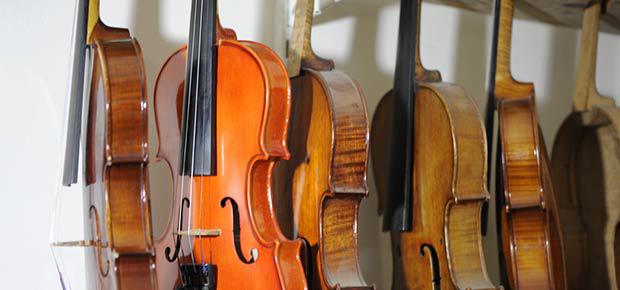
In the mid‑16th century, Andrea Amati of the Cremona school established the model of the violin as we know it today. Its lineage draws from two families: the vielle, a popular instrument played on the shoulder, and the aristocratic viol, held on the lap or between the knees like the cello.
The violin’s rise was not immediate. Court musicians were reluctant to play instruments associated with the common people. At the time, music was largely religious, and the Church was closely tied to the aristocracy. This alliance helped promote the violin. Italy embraced it brilliantly, while France initially favoured the cello.
An unexpected boost to the violin’s status in France came from the fashion for “shepherd scenes” and rustic music (Bergeries et Musiques Champêtres) at the court of Versailles. The first official sign of recognition was the King’s ensemble of 24 violins, which played to welcome hunters returning from the chase.
The baroque era—with its fascination for the divine, mythology, sentiment, and ritual—offered the perfect stage for the violin’s expressive power. Once the aristocracy recognized its value, they provided the means for its development: supporting composers, concerts, dance, instrument making, and trade, thereby strengthening artistic ties across Europe.
Cultural development became a shared heritage among the aristocratic circles of the continent.
The notion of respecting old instruments—of considering them antiques—did not exist. Many instruments deemed outdated were transformed into others: baroque guitars turned into hurdy‑gurdies, viols de gambe roughly recut into small cellos.
If luthiers possessed a particular expertise, it was in choosing wood. Myths abound, yet many woods used at the time were far from perfect: “I have seen a violin top where an original repair concealed a sap pocket, and even a large knot in the back.”
The reverence we now give to long wood‑drying periods did not exist. Dendrochronology shows that many instruments were built with wood cut only fifteen years earlier. Drying wood is wise, but it is not an ancient tradition.
Stradivari, also of the Cremona school, made far more than violins: harps, guitars, even sistrums. Instrument makers of the 18th century crafted all kinds of instruments, unlike today, where specialization is the norm.
In the baroque period, musical practice was a privilege of the upper classes—those who could afford dance lessons or hire musicians. Beyond entertainment, music expressed the ideals of the time: beauty, love, divine power.
The musician did not impose his personality; he transmitted the music faithfully to his peers, who pursued an elevated sentimental ideal. Manichaeism?
Several 18th‑century tutor books include chapters on musical expression. They say little about posture, except that the head must be held upright and majestic, the mouth and eyes relaxed and expressionless. One is reminded of the fixed smile of an accordion player performing all evening despite the weight of the instrument.
Few accessories existed at the time. Chinrests and end‑pins had not yet been invented, as playing positions were not standardized.
On ancient instruments we have examined, pegs and tailpieces are worn, replaced many times, and rarely original—yet clues remain.
Museums have not preserved the most authentic pieces. Highly ornate instruments—decorated with ivory, mother‑of‑pearl, or made for display—were seldom played and thus remain in better condition. The most genuine accessories are often found on instruments considered old‑fashioned, such as baroque guitars, hurdy‑gurdies, or violas d’amore. These may still carry original pegs or tailpieces.
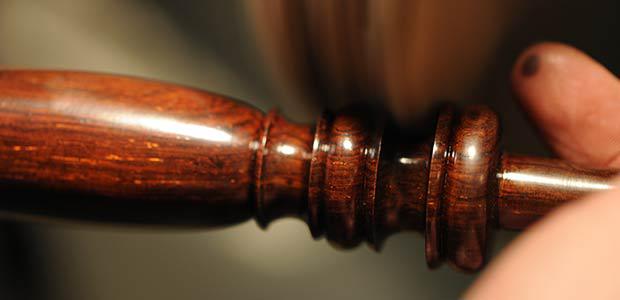
Early pegs were rustic, with no sanding—an uncommon practice. Their rough appearance carried personality, shaped by the turner’s chisel. The peg heads had flat sides and a rounded outline, leaving space between the ring and the cone. The ends often bore two fine grooves, and many were adorned with a bone button or white pip.
The baroque tailpiece was a very light trapezoidal plank of wood (less than 10 grams for a violin), slightly rounded at the top. The outer strings, E and G, formed a flatter angle than the inner strings. On modern violins, the curve is more regular, matching the bridge, and the pressure of each string is more evenly distributed.
Before exotic woods were imported, tailpieces were often veneered with fine white wood.
The chinrest was still unknown.
End‑pins with spikes did not yet exist. Cellos used only an end button.
From the French Revolution to the crisis of 1929, the industrial era began. The fall of the aristocracy empowered the bourgeoisie and shifted social and cultural balances. Mass culture emerged, and large concert halls became fashionable.
The age of steel and coal celebrated values of work, family, and homeland—patriarchal ideals that resurfaced in France in the 1940s. Slavery was abolished, yet colonization and trading posts expanded across the developing world.
Instrument making became more scientific, improving resonance and projection. Factories produced instruments in large quantities, and catalogues expanded commercial networks internationally.
Paradoxically, while mass production grew, musical interpretation became increasingly individual, giving rise to “stars.” This was also the century of invention and the celebration of human achievement. International exhibitions rewarded the work of brilliant artists, inventors, and industrialists—from the Eiffel Tower to the virtuosity of Paganini.
Among the many patents filed for instrument making, some profoundly influenced technique: metal devices to stretch fingers, braces to straighten a young violinist’s head… These innovations, though celebrated, also reflected the strict social discipline of the Victorian era, with its sombre puritanism. What a strange decline for humanity.
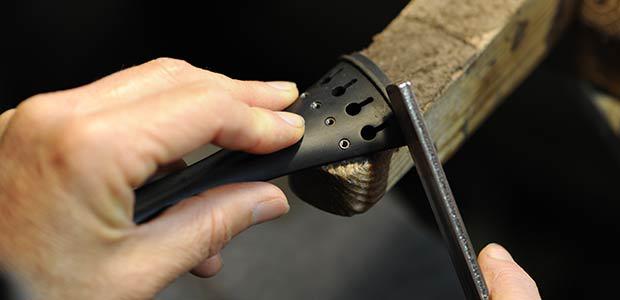
The flat peg, now commonly made of ebony or pearwood dyed black, remained the standard model. In France, rosewood pegs were frequently used and highly valued for their tuning stability. Next came the hollow peg, followed by the collar‑ring peg.
Tailpieces became thicker to withstand the increased tension of modern strings, yet narrower—perhaps to economize on wood. Their shape grew more convex, echoing the curvature of the bridge and reinforcing the power of the E and G strings.
The traditional tailgut, attached to the button with a “jumper” staple, was gradually abandoned in favour of the modern longitudinal system. This new attachment used either a hard metal wire or gut fibre.
The chinrest made its appearance in the early 19th century. A caricature from 1833 mockingly depicts it as “that famous mushroom sprouting from the edge of violins.”
At first, it was extremely discreet, little more than a small ebony tongue. While it undoubtedly dampened the instrument’s resonance to some degree, it also protected the delicate spruce top from abrasion caused by beards or the acidity of perspiration.
During the Baroque period, the cello’s tailpiece was attached with an end‑button, just like the violin. Like the bass viol, the cello was held between the thighs, a posture that reduced its projection. This was of little consequence at the time, as its role in continuo playing was to enrich the harmonic texture, remaining in the shadow of the bright, melodic instruments such as the violin or oboe.
The 19th century transformed the cello’s destiny. It gained power, expanded its range, and finally acquired a substantial solo repertoire. At last, it found its rightful place.
Curiously, cello playing was almost exclusively male. Women were discouraged from playing it for reasons that now seem absurd—its posture was deemed improper—though no one had objected a century earlier when women played the viola da gamba. It seems more likely that men wished to preserve for themselves the new soloistic prestige the instrument offered.
The introduction of a short endpin, usually made of wood, brought the instrument closer to the player’s chest and allowed for better control in rapid passages and in the upper register.